Foundation Fire Damage Assessment in Dallas, TX
While concrete foundations are generally perceived as fireproof, extreme thermal exposure and rapid cooling from fire suppression water inflict severe forensic damage on structural concrete slabs and pier-and-beam foundations. When structural fires reach temperatures above 572°F (300°C), internal moisture trapped in concrete pores vaporizes into high-pressure steam, triggering violent surface explosions known as concrete spalling. At temperatures above 932°F (500°C), the calcium hydroxide within Portland cement dehydrates and disintegrates, causing permanent compressive strength loss.
In North Texas, this thermal degradation is compounded by the notorious local soil geology: the Dallas Blackland Prairie expansive clay. Thousands of gallons of firefighting water poured onto a burning home saturate the highly expansive clay soil beneath the perimeter grade beams, inducing massive differential heave, foundation rotation, and slab fracturing. Our Dallas foundation assessment team provides engineering-grade forensic inspections across all 51 Dallas ZIP codes.
Dallas General Contractor & Structural Desk
Licensed Texas General Contractor & PE structural engineers deploying framing & rebuild crews.
Thermal Concrete Failure Modes During Structural Fires
Concrete foundation assemblies experience multiple physical and chemical transformations when exposed to intense fires:
Thermal Concrete Spalling
Free water and bound water rapidly convert to steam. Internal pressure blows off chunks of concrete cover, exposing structural steel reinforcement to open flames and soot acids.
Internal Steel Rebar De-Bonding
Reinforcing steel expands at a different rate than concrete. As rebar heats, it breaks mechanical bonds with the cement matrix, permanently degrading load capacity.
Post-Tension Cable Anchorage Failure
Dallas post-tension slabs feature steel cables stressed to 33,000 lbs. Extreme heat can anneal steel cable strands or melt protective sheaths, risking tendon failure.
Expansive Clay Soil Heave
Dallas Blackland Prairie clay soil saturates from firefighting water, expanding rapidly and lifting perimeter beams while dried center sections sag, fracturing slabs.
Non-Destructive & Laboratory Testing Methodologies
Our structural engineering partners utilize advanced diagnostic procedures:
Schmidt Rebound Hammer & Ultrasonic Testing
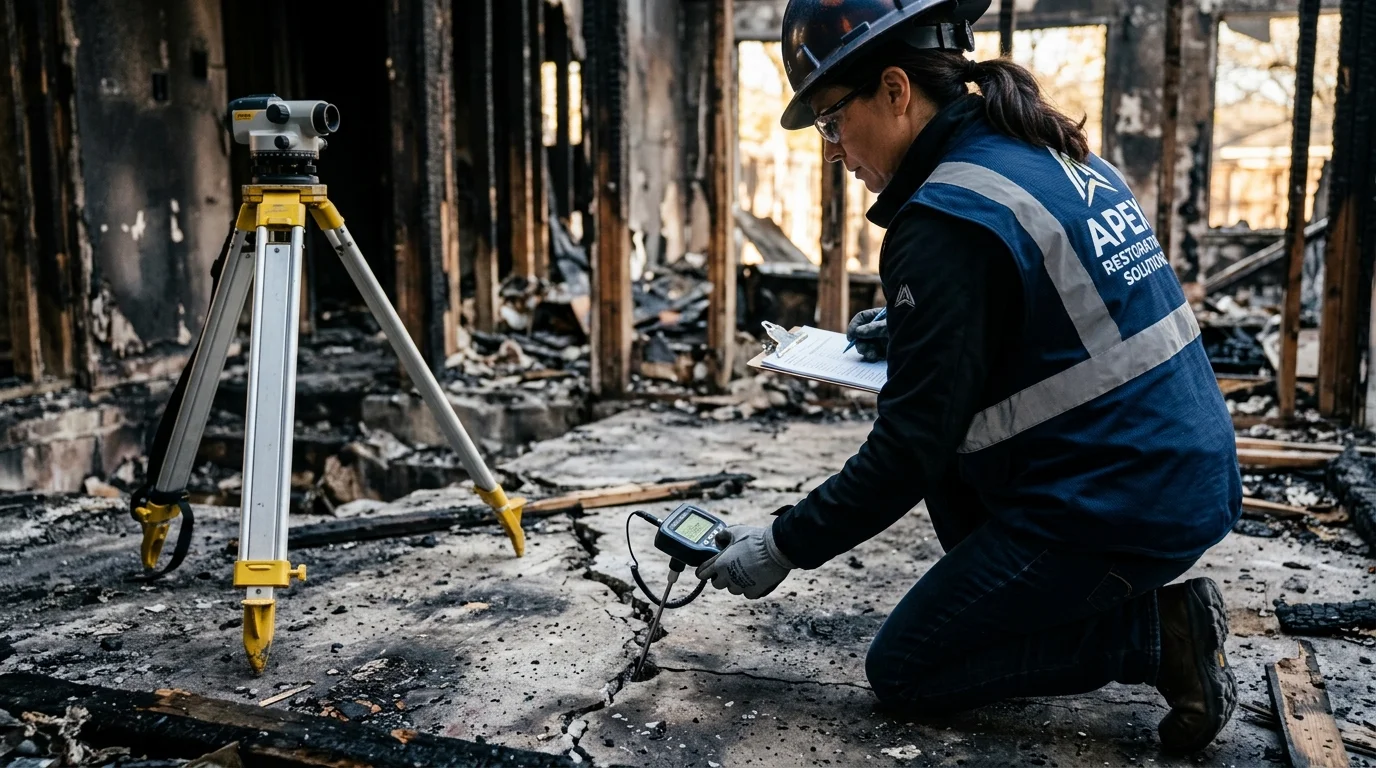
Schmidt Rebound Hammer Testing (ASTM C805) measures surface rebound hardness to map areas of compressive strength loss across the slab.
Ultrasonic Pulse Velocity Testing (ASTM C597) measures acoustic wave speeds through concrete to detect subsurface micro-cracks and steam voids.
Digital Elevation Surveys & Core Sampling
Precision digital manometer surveys measure slab elevation contours down to 1/10th of an inch, mapping differential settlement or water-induced clay heave.
For severely burned slabs, diamond core drills extract concrete cylinders for laboratory compression testing to verify residual PSI ratings.
Frequently Asked Questions
Can a fire-damaged concrete slab foundation be repaired without tearing down the house?
Yes. Depending on the depth of thermal damage and engineering findings, foundations can often be restored using high-strength structural epoxy injection for cracks, polymer-modified structural concrete mortar overlays for spalled areas, and carbon fiber reinforcement grid wrapping. If expansive soil has caused differential settlement, hydraulic steel push piers or helical piers can level and stabilize the perimeter grade beams.
How does firefighting water affect Dallas foundations?
Dallas sits on highly active expansive clay soil (Eagle Ford and Austin Chalk formations). When thousands of gallons of firefighting water saturate the soil along the exterior walls, the clay swells dramatically, pushing upward against the perimeter grade beams and causing foundation heave and interior sheetrock cracking.
What is concrete spalling, and why is it dangerous?
Spalling occurs when moisture inside the concrete turns into pressurized steam during a fire, blowing out surface concrete. It is dangerous because it weakens the slab's compressive thickness and exposes steel rebar to open heat, oxygen, and corrosive soot acids, leading to rapid rebar failure.
Does the City of Dallas require a foundation engineering report after a structural fire?
If there is evidence of slab cracking, spalling, post-tension anchor damage, or differential settlement, the City of Dallas Building Inspection Division requires a stamped structural engineering report from a licensed Texas Professional Engineer before approving reconstruction permits.
Related Structural & Rebuilding Solutions
Engineering-grade structural repairs and framing sistering.
Pier-and-beam crawlspace leveling and joist sistering.
Complete ground-up and down-to-studs rebuilding.
Forensic load-bearing engineering assessment across Dallas.
Available Across All 51 Dallas ZIP Codes
Our emergency response and restoration specialists deploy 24/7 across every Dallas County neighborhood. Select your local district below for localized response details:
Fire Recovery & Technical Insights
What to Do in the First 24 Hours After a House Fire
Critical safety, insurance notification, and board-up steps once fire officials release the scene.
Understanding Smoke and Soot Types: Wet, Dry & Protein
Why household cleaning smears acidic soot and how chemical counteractants stop etching.
Navigating Fire Damage Insurance Claims
How Xactimate line-item estimates, ACV vs RCV, and Texas building ordinance coverage work.