Post-Fire Moisture Control in Dallas, TX
In the wake of firefighting operations, structural drying cannot rely on guesswork or superficial surface touch tests. Materials that feel dry to the hand—such as painted drywall surfaces, hardwood floorboards, and concrete foundation slabs—often harbor dangerous moisture reservoirs deep within their internal core or wall cavities.
In Dallas's warm, humid climate, undetected pockets of moisture trigger rapid fungal colonization within 24 to 48 hours. Our Dallas moisture control division deploys calibrated laboratory-grade detection instruments, high-resolution FLIR thermal imaging cameras, and digital psychrometric logging to safeguard properties against secondary decay.
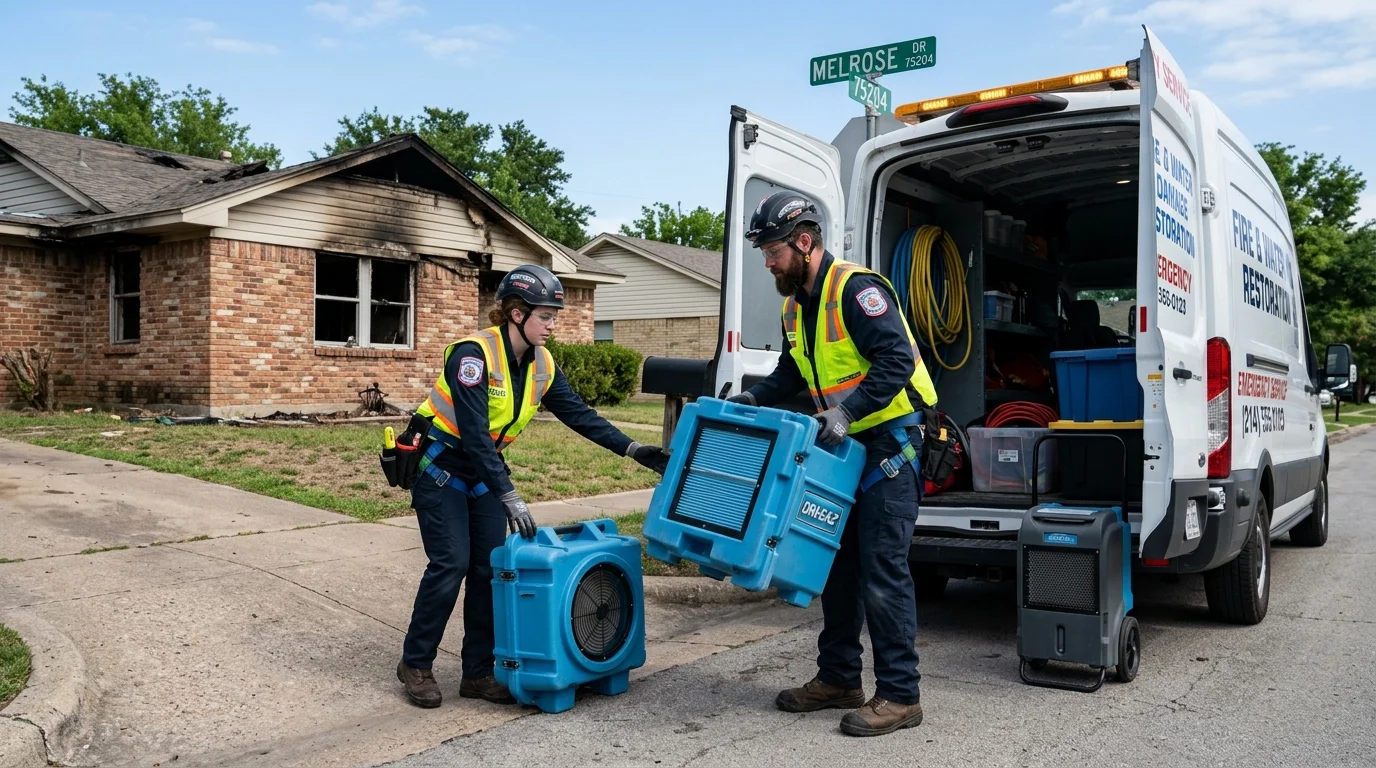
Dallas Firefighting Water Extraction & Drying Desk
IICRC certified water extraction specialists & structural psychrometric drying crews deployed across Dallas County.
The Three-Tiered Moisture Mapping Protocol
Our certified moisture control technicians execute a rigorous three-phase diagnostic protocol on every fire loss:
1. FLIR High-Resolution Infrared Thermal Scanning
Room-by-room infrared surveys identify evaporative temperature anomalies, instantly revealing hidden water pathways behind finished drywall and beneath flooring.
2. Quantitative Moisture Content Metering
Non-destructive radio frequency meters, deep-pin resistance probes (% WME), and in-situ concrete relative humidity probes (ASTM F2170) measure exact moisture values.
3. Psychrometric Atmospheric Monitoring
Twice-daily tracking of ambient temperature, relative humidity, Grains Per Pound (GPP), and vapor pressure differentials ensures continuous, turbulent evaporation.
Establishing North Texas 'Dry Standards'
Drying goals must reflect the regional equilibrium moisture content (EMC) of Dallas, Texas:
Framing Lumber (SPF / Douglas Fir)
Target dry standard: 10% to 12% Wood Moisture Equivalent (WME), down from saturated levels exceeding 35% to 45%.
3/4" Plywood / OSB Subflooring
Target dry standard: 8% to 11% WME to prevent subfloor adhesive failure and edge swelling.
Gypsum Drywall
Target dry standard: < 12% to 15% relative scale to prevent mold colonization on paper backings.
Concrete Slab-on-Grade
Target dry standard: < 75% to 80% Internal Relative Humidity per ASTM F2170 before flooring installation.
Frequently Asked Questions
Why does a room still smell musty if the surfaces look dry?
A persistent musty odor after water extraction indicates hidden moisture trapped inside wall cavities, beneath subfloors, or behind baseboards. Damp organic materials support microscopic bacterial and fungal colonies that release volatile organic compounds (MVOCs) into the air. Our thermal imaging and deep pin probes pinpoint these hidden moisture pockets so they can be dried completely.
How often do technicians inspect moisture levels during drying?
Our technicians perform daily psychrometric inspections every 24 hours throughout the drying cycle. We record temperature, relative humidity, GPP, and material moisture content on digital drying logs, adjusting air mover positioning and dehumidifier capacity to maximize drying speed.
Can high humidity in Dallas slow down the structural drying process?
Yes. When outdoor relative humidity is high, opening windows or pulling outdoor air inside introduces excess moisture, stalling the evaporation process. We maintain a sealed, closed-drying chamber environment, utilizing industrial LGR and desiccant dehumidifiers to keep indoor relative humidity below 30% to 40% regardless of outside weather conditions.
Related Suppression Water & Drying Solutions
Comprehensive fire suppression water extraction and drying.
Industrial LGR and desiccant structural dehumidification.
Attack line suppression water extraction and wall cavity drying.
Commercial and residential sprinkler deluge water remediation.
Available Across All 51 Dallas ZIP Codes
Our emergency response and restoration specialists deploy 24/7 across every Dallas County neighborhood. Select your local district below for localized response details:
Fire Recovery & Technical Insights
What to Do in the First 24 Hours After a House Fire
Critical safety, insurance notification, and board-up steps once fire officials release the scene.
Understanding Smoke and Soot Types: Wet, Dry & Protein
Why household cleaning smears acidic soot and how chemical counteractants stop etching.
Navigating Fire Damage Insurance Claims
How Xactimate line-item estimates, ACV vs RCV, and Texas building ordinance coverage work.