Exterior Wall Fire Damage Repair in Dallas, TX
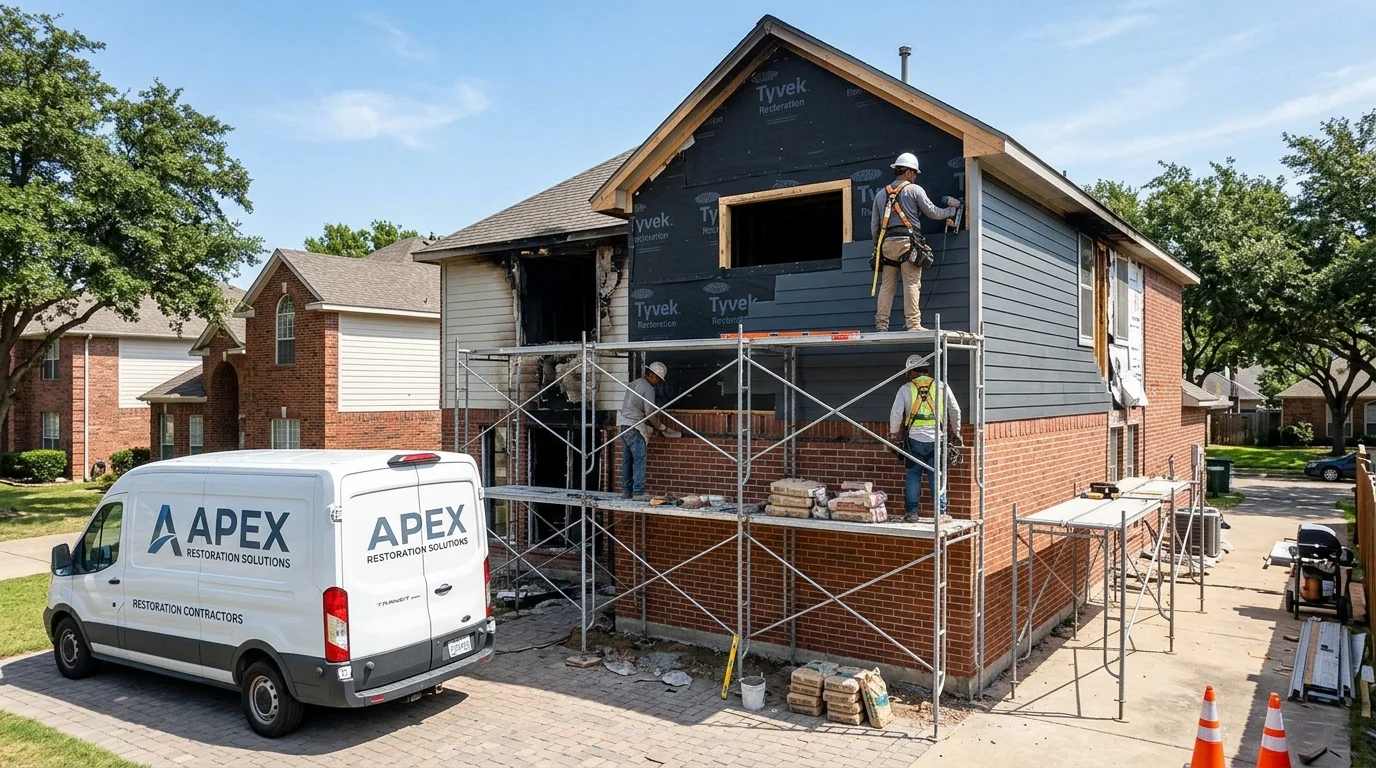
Exterior wall claddings are the architectural exterior skin of a building, responsible for aesthetic curb appeal, shedding bulk precipitation, and withstanding severe North Texas weather. When a fire occurs—whether originating from inside and blowing out through windows or ignited externally from barbecue grills, landscape mulch, or adjacent structure fires—exterior wall claddings suffer extensive cosmetic and functional destruction. Vinyl siding melts and puddles; fiber cement panels scorch and crack; exterior stucco dehydrates, cracks, and delaminates; and brick veneer experiences thermal spalling and soot staining.
Our Dallas exterior finishing restoration division provides complete cladding repair and surface restoration across Dallas County. Operating under registered Texas General Contractor standards, our specialized cladding tradesmen handle fiber cement siding replacement (James Hardie), multi-coat exterior stucco patching, brick masonry repointing, and weather-resistant paint finishing under City of Dallas Chapter 53 Building Code standards.
Dallas General Contractor & Structural Desk
Licensed Texas General Contractor & PE structural engineers deploying framing & rebuild crews.
Heat Vulnerabilities of Common Dallas Exterior Claddings
Different exterior finishes react uniquely to fire exposure and require distinct repair techniques:
Vinyl Siding Melting & Distortion
Melts and sags at temperatures as low as 160°F, leaving underlying house wrap exposed. Warped panels must be completely unzipped and replaced.
Fiber Cement Siding (HardiePlank)
Extreme heat blisters paint, calcines the Portland cement matrix, and causes micro-cracking and brittleness, requiring panel replacement.
Stucco Dehydration & Delamination
High heat dehydrates the cementitious binder, creating spiderweb cracks and separating brown coats from wire lath. Synthetic EIFS foam melts behind acrylic finishes.
Brick Veneer & Mortar Spalling
Mortar joints weaken and turn powdery above 600°F. Radiant heat can also cause brick face spalling and intense carbon soot staining deep into clay pores.
Technical Exterior Cladding Repair Procedures
We restore exterior weather barriers and pristine aesthetics:
Selective Removal & Weather Barrier Splicing
Damaged cladding is removed back to natural architectural break lines (corners or expansion joints).
Underlying weather barrier wrap is spliced with minimum 6-inch vertical and 12-inch horizontal laps and sealed with flashing tape.
Fiber Cement Siding, Stucco & Masonry Repointing
New fiber cement lap siding is blind-nailed into studs with hot-dipped galvanized nails and backed with aluminum joint flashings.
Three-coat traditional stucco is applied and textured to match existing finishes (dash, lace, sand, or smooth).
Fire-damaged mortar is raked out 3/4 inch deep and tuck-pointed with custom-tinted Type N masonry mortar, followed by elastomeric paint coating.
Frequently Asked Questions
Can you match the color of my existing weathered exterior siding?
Yes. We take physical samples of your existing siding to our commercial paint suppliers for spectrophotometer computer color analysis. This creates an exact formula matching the current weathered, UV-aged color of your exterior cladding rather than the brand-new factory swatch.
What should be done if the house wrap behind the siding was melted by the fire?
The melted house wrap must be cut away, and new weather-resistive barrier paper must be spliced under the sound wrap above with a minimum 6-inch vertical lap and 12-inch horizontal lap. Skipping this step leads to hidden water leaks and framing rot during heavy Dallas rainstorms.
Can soot-stained exterior brick be pressure washed clean?
High-pressure washing alone can drive acidic soot particles deeper into porous brick and blast away fragile mortar joints. We apply specialized chemical soot-lifting poultices and alkaline restoration detergents that chemically release the carbon bond, followed by gentle, low-pressure hot water rinsing.
Does repairing exterior siding require a building permit in Dallas?
Cosmetic replacement of a small area of siding typically does not require a permit, but any exterior repair involving structural wall sheathing, window header modifications, or extensive re-siding requires an alteration permit from the City of Dallas Building Inspection Division.
Related Structural & Rebuilding Solutions
Drywall, trim, and window finishing repair services.
Exterior structural framing, shear wall sheathing, and building envelope.
Heat-warped frame replacement and Low-E glazing installation.
Complete ground-up and down-to-studs rebuilding.
Available Across All 51 Dallas ZIP Codes
Our emergency response and restoration specialists deploy 24/7 across every Dallas County neighborhood. Select your local district below for localized response details:
Fire Recovery & Technical Insights
What to Do in the First 24 Hours After a House Fire
Critical safety, insurance notification, and board-up steps once fire officials release the scene.
Understanding Smoke and Soot Types: Wet, Dry & Protein
Why household cleaning smears acidic soot and how chemical counteractants stop etching.
Navigating Fire Damage Insurance Claims
How Xactimate line-item estimates, ACV vs RCV, and Texas building ordinance coverage work.