How to Choose a Fire Damage Restoration Company in Dallas
Hiring the wrong contractor after a house fire costs Dallas homeowners time, money, and claim leverage. Use these six vetting steps, a side-by-side comparison checklist, and the red flags that should end a conversation.
Key Answer & Essential Rule
Choose a fire damage restoration company in Dallas by verifying insurance and applicable Texas licensing, confirming IICRC certifications such as FSRT, WRT, and OCT, checking that the company answers a 24/7 line with crews based in the DFW area, and requiring a written, itemized scope before anything is signed. Prefer a single contractor who can carry the job from emergency board-up through reconstruction, and walk away from anyone who pressures you to sign on the spot, offers to absorb your deductible, or asks to negotiate the claim on your behalf.
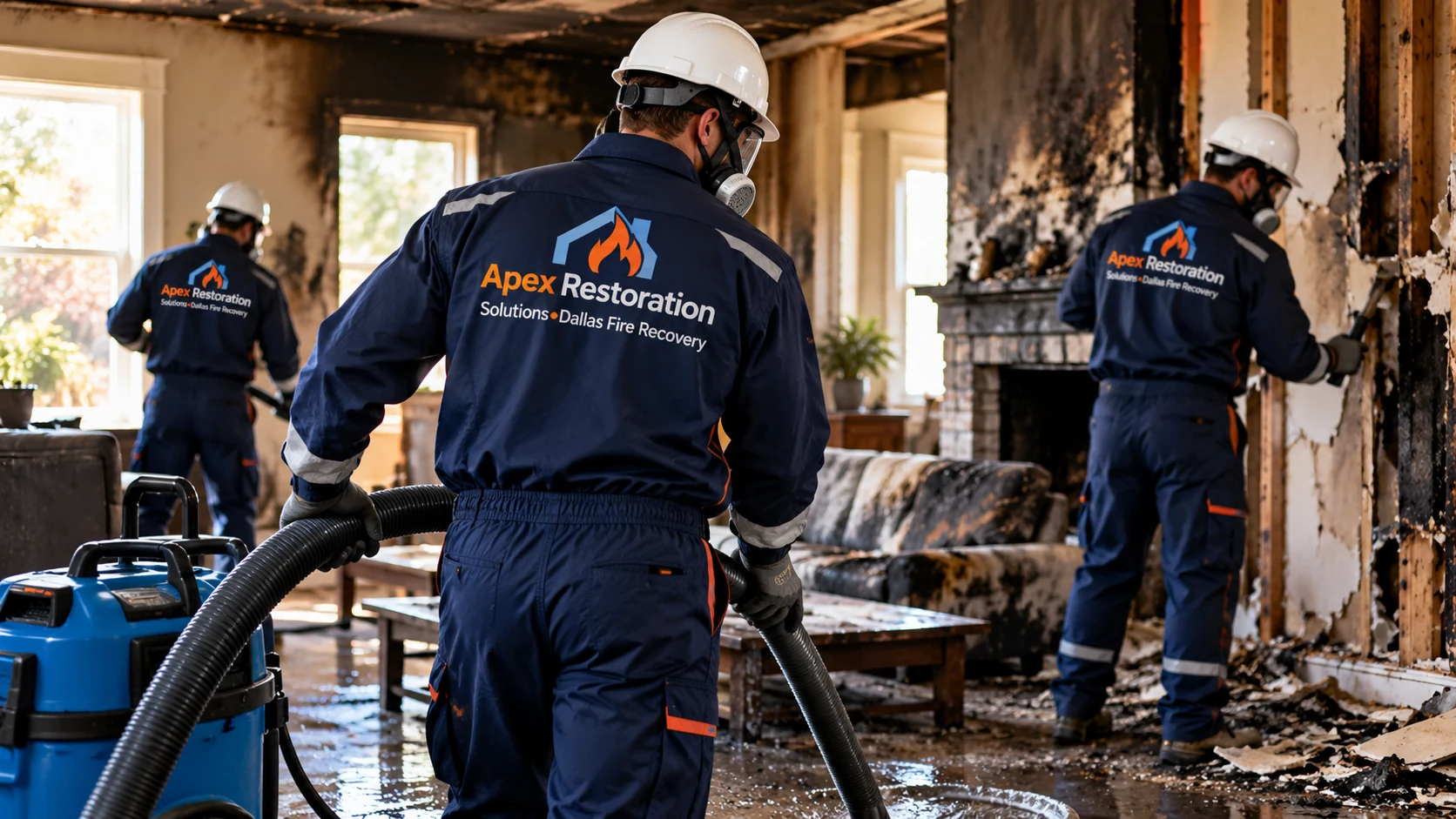
How Do You Choose a Fire Damage Restoration Company in Dallas?
After a fire, homeowners are usually approached by several contractors at once, often before the scene is fully released. That pressure is exactly why a structured process matters. Knowing how to choose a fire damage restoration company before you sign anything protects both your property and your claim, because the contractor you pick controls the quality of the documentation your adjuster will rely on for months.
The stakes are practical. Soot is acidic and keeps etching metal, glass, and finishes while you deliberate, and firefighting water left in wall cavities can begin supporting mold growth within a couple of days in the North Texas climate. Moving fast is necessary; skipping verification is not. If you are also budgeting the project, our Dallas fire damage restoration cost guide explains how estimates are built.
Step 1: Verify Licensing, Insurance, and Technician Certifications
Because Texas does not issue a blanket general contractor license, some companies rely on that gap and present vague credentials. The individual trades are regulated, though: electrical and plumbing repairs must be performed by licensed trades, and mold remediation is licensed separately through the Texas Department of Licensing and Regulation. Ask who holds each credential on your specific job, not who the company employs in general.
Certification matters because fire restoration is a technical discipline rather than cleaning. The chemistry used on oily kitchen-fire residue differs from what works on dry, high-heat soot, and the wrong product can permanently set a stain. A company that can name its crew leads' certifications and explain why a method suits your residue type is demonstrating competence you can verify, and our fire damage restoration operations in Dallas page outlines the divisions a full-scope restorer should be able to staff.
Texas-Specific Credential to Check
If firefighting water saturated the structure, mold remediation may enter the scope. Texas rules administered by the Texas Department of Licensing and Regulation require licensed mold assessment and remediation once the affected area exceeds a defined threshold of contiguous square footage. Ask upfront whether the company holds that license or subcontracts it, and verify the number through the TDLR public lookup before work begins.
Step 2: Confirm True 24/7 Response and a Real Dallas Presence
Speed is not a marketing claim in fire restoration; it changes the outcome. Broken windows and a compromised roof expose your interior to rain, wind, and trespassers, and most Texas homeowners policies include a duty to protect the property from further loss. Delayed emergency board-up and property securing can give a carrier grounds to dispute secondary damage that occurred while the structure sat open.
Local presence also matters for the long tail of the project. Permitted reconstruction in Dallas involves city inspections, scheduling, and return visits for punch-list work. A restoration contractor who already works across the Dallas service areas is still reachable in month three, which is usually when homeowners discover a missed detail.
Step 3: Ask Whether One Company Can Carry the Entire Project
Ask directly: does your company perform the rebuild, or do you stop after mitigation? Many cleanup-only firms offer to refer you to a builder, and that referral is where projects stall, because the two scopes are written separately and rarely reconcile cleanly against one settlement.
Use the phase table below as a live checklist during site visits, and ask each estimator to confirm in writing which phases their contract covers. Gaps in firefighting water extraction and drying and HVAC and air quality work are the two most commonly omitted phases, and both cause problems that surface months later.
| Restoration Phase | What It Involves | Why It Cannot Be Skipped |
|---|---|---|
| Emergency response & board-up | Securing openings, roof tarping, site stabilization | Policies require you to prevent further loss |
| Inspection & scope documentation | Structural, smoke, moisture, and HVAC assessment | Defines the itemized scope your adjuster funds |
| Debris & soot cleanup | Charred material removal, ash and hazardous debris disposal | Acidic residue etches surfaces until removed |
| Smoke, soot & odor treatment | Surface cleaning, sealing, thermal fogging or hydroxyl treatment | Odor returns in humidity if surfaces were only wiped |
| Water extraction & structural drying | Extraction, psychrometric drying, moisture verification | Trapped suppression water causes secondary mold damage |
| Reconstruction & finishing | Framing, drywall, electrical, flooring, finish work to code | Returns the home to pre-loss, code-compliant condition |
Use this as a scope checklist when comparing proposals. Ask each company to mark which phases fall inside their contract and which would be subcontracted or excluded.
Step 4: Evaluate Their Insurance Documentation Process
Under the Texas Insurance Code, adjusting a claim on behalf of a policyholder requires a public adjuster license, and a contractor repairing the property is prohibited from acting as the public adjuster on that same claim. A company that blurs the line is either unfamiliar with Texas law or willing to ignore it. A legitimate restorer supports the claim with documentation and fire damage insurance assistance rather than taking it over.
Documentation quality is also where underpaid claims originate. Hidden attic charring, soot drawn into return ducts, and moisture under flooring are routinely missed on a quick walkthrough, and anything absent from the initial scope must be argued later as a supplement. A thorough fire damage inspection prevents that, and our guide to navigating fire damage insurance claims covers the homeowner side of the process.
Two Texas Laws Worth Knowing Before You Sign
Texas law makes it an offense for a contractor to pay, rebate, or waive an insurance deductible as an inducement to hire them, so an offer to cover your deductible is not a discount, it is a signal to walk away. Separately, a contractor who repairs your property may not act as a public adjuster on that claim. Both pitches are common after a loss, and both should end the conversation.
Step 5: Compare Written Estimates, Contracts, and References
Lump-sum numbers are impossible to compare across bidders and impossible for an adjuster to verify. Line-item estimates reveal that one company priced duct cleaning and sealing while another did not, which usually explains most of the gap between two quotes. If a proposal is materially cheaper, find the missing line items first; our cost breakdown for Dallas fire restoration shows which components normally appear on a complete estimate. Confirm too that the warranty covers both structural repair and reconstruction and the cleaning and deodorization work, not only the rebuild.
When you reach a reference, ask three questions: did the final cost match the written estimate, did the odor come back after the first humid week, and how responsive was the company once the check cleared. Reputation also shows in how an estimator treats your questions. Someone who explains why they recommend hydroxyl or thermal fogging odor treatment for your residue type, and is comfortable with you taking notes, is behaving like a technical professional.
Fire Damage Restoration Company Comparison Checklist
Print or screenshot this table and take it to each site visit. Scoring every bidder on the same eight questions is the most effective way to tell a well-run restoration company from a well-rehearsed sales call, and it takes about ten minutes per contractor.
| What to Ask | A Strong Answer Sounds Like | Warning Sign |
|---|---|---|
| Are you insured, and which trades on my job are licensed? | Insurer-issued certificate plus named electrical, plumbing, and mold credentials | Verbal assurance only; won't put credentials in writing |
| Which technicians hold IICRC certifications? | Names FSRT, WRT, and OCT holders assigned to your project | Cannot name a certifying body or any certificate holder |
| How quickly can a crew be on site, and from where? | A specific response window and a DFW-area staging location | Vague promises and an answering-service callback |
| Do you handle both mitigation and reconstruction? | One contract and one warranty, board-up through rebuild | Stops after cleanup; refers you to an unnamed builder |
| Will I receive an itemized written estimate? | Line-item scope separating labor, materials, and equipment by room | Lump-sum verbal figure, or billing whatever insurance approves |
| How will you document the loss for my adjuster? | Dated photo logs, moisture readings, and a line-item estimate | Offers to handle or negotiate the claim on your behalf |
| Can I contact recent Dallas fire-loss customers? | Local references from comparable jobs within the past year | Only out-of-area references, or none at all |
| What are the payment terms and warranty? | Milestone-based schedule, written warranty on all phases | Large cash deposit up front, or an offer to waive your deductible |
Score each company on all eight rows before comparing price. A lower bid that fails rows one through four is not a lower bid, it is a smaller and different scope of work.
What Are the Biggest Red Flags When Hiring a Restoration Company?
Door-knocking after a widely reported fire is the most common pattern. Out-of-area crews arrive, collect deposits across a neighborhood, perform partial demolition, and leave homes opened up and unfinished, with no local entity left to hold accountable.
A quieter red flag is scope that shrinks as the conversation progresses. If duct cleaning, sealing, contents cleaning, or post-fire mold prevention were discussed verbally but never appear in the written proposal, they are not in the job. Insist that everything promised on site appears in the signed scope, and if your fire happened within the last day, follow our first 24 hours after a house fire checklist before committing to any contractor.
Making the Final Decision on a Dallas Restoration Partner
Knowing how to choose a fire damage restoration company comes down to replacing urgency with process: verify credentials, demand written detail, confirm the full scope is covered, and check that the company will still be reachable in Dallas when the punch list is finished. Those four habits filter out nearly every bad outcome homeowners report after a fire.
If your Dallas home or business has sustained fire, smoke, or soot damage, our certified local team provides documented on-site assessments, itemized scopes your adjuster can review, and complete restoration from emergency board-up through final reconstruction. Call our 24/7 Dallas response line or request an assessment online to get a written scope you can compare with confidence.
Need Professional Assessment or Assistance?
Explore our dedicated technical division for Fire Damage Restoration in Dallas, find mobile response teams across all 51 Dallas coverage areas, or review our comprehensive Dallas fire damage restoration operations.
Frequently Asked Questions
How do I know if a fire damage restoration company is legitimate?
Verify three things in writing before signing: a certificate of general liability and workers compensation insurance issued by the insurer, IICRC certifications such as FSRT, WRT, and OCT held by technicians assigned to your job, and licenses for any regulated trades in your scope, including electrical, plumbing, and mold remediation. Confirm the business operates from a real Dallas-area location and can provide references from recent local fire losses.
Does my insurance company get to choose my restoration contractor?
Insurers often recommend contractors from a preferred vendor program, but as a Texas policyholder you generally have the right to select your own licensed contractor. A carrier may still require that the work and pricing be reasonable and documented, which is why an itemized, line-item estimate matters. Review your policy language and the Texas Department of Insurance consumer resources if an adjuster suggests you must use a specific company.
Should I hire separate companies for smoke cleanup and reconstruction?
Using one full-scope restoration company is usually better. A single contractor carries one scope, one timeline, and one warranty from board-up through rebuild, which removes the handoff gaps where issues like soot left in ductwork or moisture under flooring get missed. Splitting the work also produces two separate estimates that rarely reconcile cleanly against one insurance settlement.
What certifications should a fire damage restoration company have?
Look for IICRC certifications relevant to fire recovery: FSRT (Fire and Smoke Restoration Technician) for soot and smoke work, WRT (Water Damage Restoration Technician) for firefighting water extraction and structural drying, and OCT (Odor Control Technician) for deodorization. In Texas, mold remediation above a defined area threshold additionally requires a license issued through the Texas Department of Licensing and Regulation, which you can verify through its public license lookup.
How quickly should I hire a restoration company after a fire?
Arrange emergency board-up and stabilization within the first day, once the fire department has released the scene, because most policies require you to prevent further damage. Acidic soot continues etching surfaces within hours, and firefighting water can begin supporting mold growth within roughly 24 to 48 hours in the North Texas climate. You can authorize emergency mitigation quickly while still taking a day or two to vet the contractor who will perform the full restoration and rebuild.