Baseboard Fire Damage Repair in Dallas, TX
Interior architectural trim—including baseboards, quarter-round shoe molding, door casings, window stools, and crown molding—frames the visual character of a home. During a fire event, interior millwork suffers dual destruction: radiant heat scorches, blisters, and chars exposed surfaces, while thousands of gallons of firefighting water run along floors and pool directly behind baseboards. Standard modern trim manufactured from MDF (medium-density fiberboard) acts like a sponge, absorbing water, swelling dramatically, delaminating, and trapping stagnant moisture and soot against the drywall.
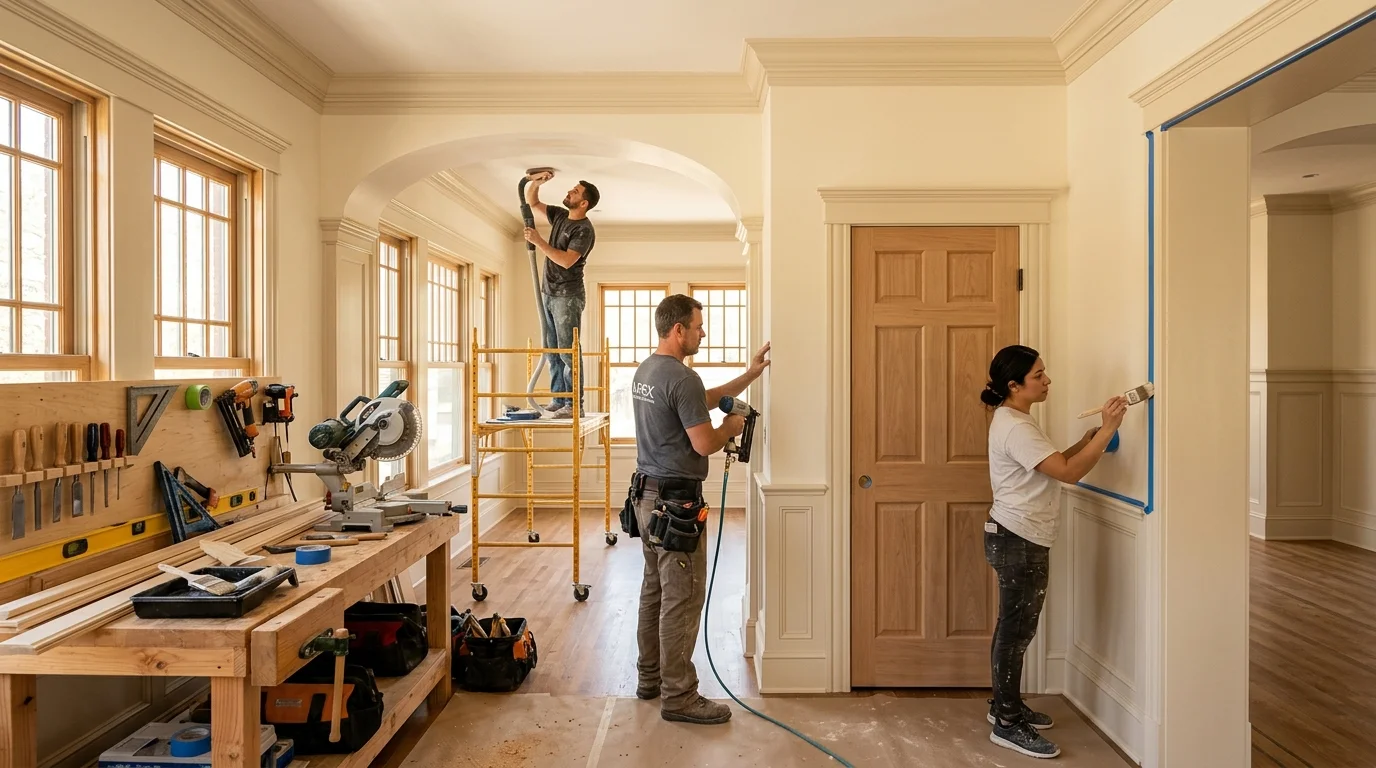
Our Dallas interior trim restoration team provides precision baseboard and architectural molding repair across all Dallas County neighborhoods. Operating under licensed Texas General Contractor standards, our finish carpenters execute surgical trim removal, custom historic molding profile replication, precision miter cutting, and high-durability enamel finishing.
Dallas General Contractor & Structural Desk
Licensed Texas General Contractor & PE structural engineers deploying framing & rebuild crews.
The Anatomy of Trim Damage: Heat, Water & MDF Swelling
Interior trim exhibits distinct failure modes depending on its material composition:
MDF Swelling & Delamination
Medium-density fiberboard wicks water upward, expanding to more than twice its original thickness. Once swollen, MDF cannot be sanded smooth; it must be completely removed.
Solid Wood Warping & Cupping
Solid pine, oak, or poplar trim can warp, cup, and pull away from wall studs as moisture saturates the back while high heat dries the front face.
Blistered Enamel & Charred Edges
Radiant room heat blisters oil and latex enamel paints, infusing toxic soot compounds into raw wood grain.
Behind-the-Baseboard Mold Traps
The expansion gap between subfloors and drywall traps water and soot behind baseboards, creating a prime breeding ground for toxic black mold.
Technical Trim Restoration & Replacement Procedures
Our finish carpenters restore pristine architectural lines:
Surgical Removal & Substrate Priming
Carpenters score the paint seal along the top edge of baseboards with utility knives to avoid tearing drywall face paper.
Bottom wall plates and drywall margins are dried below 12% moisture and sealed with pigmented shellac primer.
Coped Joints & High-Performance Enamel Finishing
Baseboards feature 45-degree scarf joints on long runs, coped inside corners to accommodate seasonal wood movement, and crisp mitered outside corners.
Nail holes are filled, joints are caulked with elastomeric acrylic caulk, and two coats of waterborne alkyd enamel paint provide a rock-hard washable finish.
Frequently Asked Questions
Why do you cope inside baseboard corners instead of miter cutting them?
In Dallas's variable climate, timber framing naturally expands and contracts with shifting humidity. A 45-degree mitered inside corner opens up and leaves unsightly gaps when wood shrinks. A coped joint fits the contoured profile of one board over the flat face of the other, maintaining a tight, gap-free seam regardless of seasonal wood movement.
Can water-damaged MDF baseboards be dried out and saved?
No. Once MDF fibers absorb water, the compressed wood binders break down permanently. The board swells, loses structural rigidity, and will crumble over time. All water-saturated MDF trim must be removed and replaced.
How do you match the trim profile of older historic Dallas homes?
We remove a clean 6-inch sample of the original undamaged wood molding, trace its contour on optical shapers, and either source exact architectural reproductions or custom-mill replacement lengths from premium solid pine, poplar, or oak.
Will replacing baseboards damage my new hardwood or tile flooring?
No. Baseboards and shoe moldings are installed on top of finished flooring with protective shims and painter's tape barriers. Shoe molding is nailed directly into the baseboard—never into the floor—allowing the flooring to float and expand naturally beneath.
Related Structural & Rebuilding Solutions
Drywall, trim, and window finishing repair services.
Type X sheetrock hanging, Level 4/5 finishes, and texture matching.
Heat-warped frame replacement and Low-E glazing installation.
Targeted rebuilds of kitchens, master suites, and living rooms.
Available Across All 51 Dallas ZIP Codes
Our emergency response and restoration specialists deploy 24/7 across every Dallas County neighborhood. Select your local district below for localized response details:
Fire Recovery & Technical Insights
What to Do in the First 24 Hours After a House Fire
Critical safety, insurance notification, and board-up steps once fire officials release the scene.
Understanding Smoke and Soot Types: Wet, Dry & Protein
Why household cleaning smears acidic soot and how chemical counteractants stop etching.
Navigating Fire Damage Insurance Claims
How Xactimate line-item estimates, ACV vs RCV, and Texas building ordinance coverage work.